Welcome to HRA Latest with news and updates for those working or involved in health and social care research.

This month we've got two really interesting blogs that I'd encourage you to take a look at.
The first highlights guidance that can help researchers to use health information to identify people to invite to take part in research in a way they can trust.
The second is about our work on the AI Airlock, which provides a safe space for regulators and developers to come together to work through some of the trickiest questions around AI in healthcare.
You can also read more about the work our amazing volunteers do with us. We've got a brilliant interview with one of our REC members, Joe, who is a lay member and offers crucial insight from someone not directly involved in research. There's also a shout out to two different RECs for their role in reviewing a world first clinical trial for a vaccine that doesn't need to be kept cool in a fridge.
Finally I give an update on the legal challenge to the PATHWAYS Trial, and share our response to the MHRA's consultation on a proposed regulatory framework for rare disease therapies.
For regular updates and the latest news, you can also follow us on LinkedIn.
Matt Westmore, Chief Executive
|
Finding and contacting people about research: putting our guidance into practice
Last year we published guidance on the legal, policy and ethical issues of recruiting research participants.
The guidance is intended to help researchers to use health information to identify people to invite to take part in research. It is crucial though that this is done in a way that people can trust.
Dr Alison Knight, Data and Privacy Specialist and Research Data Policy Lead, has written a blog reflecting on the guidance and the practical things that researchers should be considering around recruitment.
If you are designing a recruitment pathway for a trial, make sure you take a look at Alison's blog.
An update on PATHWAYS TRIAL
PATHWAYS is a programme of research aiming to help find out how the NHS can better support children and young people with gender incongruence.
A legal challenge against the approval for this clinical trial was brought by a campaign group earlier this year. On 31 July this challenge was rejected by the High Court.
The decisions made around high profile studies like PATHWAYS TRIAL will always attract extra scrutiny and we welcome the opportunity to assure the public of the safeguards put in place to protect research participants.
We are grateful to the Court for its careful consideration of this case, and its recognition that Research Ethics Committees (REC) have the right expertise to review complex studies like this.
We would like to thank the volunteers who sat on the REC that reviewed the study for their time, expertise and careful consideration of these important ethical questions.
New MHRA rare diseases consultation
We have responded to the Medicines and Healthcare products Regulatory Agency's (MHRA) consultation on a proposed regulatory framework for rare disease therapies.
In our response, we support the principle of bringing more rare disease treatments into a regulated, evidence-generating pathway rather than relying on off-label use. We highlight that a regulated route can provide stronger safeguards for patients through ethical review, safety monitoring, transparency and structured evidence generation.
The consultation aims to support the development of treatments for very rare conditions by creating a regulated pathway that enables earlier patient access while continuing to generate evidence on safety and effectiveness.
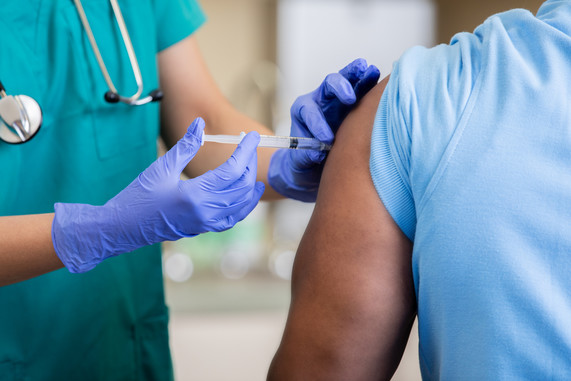
Innovative fridge-free vaccine clinical trial results announced
Earlier this month, the results of a world first clinical trial for a vaccine that doesn't need to be kept cool in a fridge were published, potentially improving access to vital treatments.
Now that the results for this trial have been confirmed, scientists are running a second clinical trial to further assess the vaccine in a larger group of participants.
As part of the approvals process, the initial phase 1 trial application was reviewed by members of London Bridge Research Ethics Committee (REC) and the phase 2b trial was reviewed by members of West London Gene Therapy Advisory Committee REC.
Insights from the AI Airlock
In a new blog, Gemma Warren, HRA's Policy Manager for Data and AI, shares the insights we've gained over the past two years from the development of the Medicines and Healthcare products Regulatory Agency's (MHRA) AI Airlock.
The Airlock is a space where regulators and developers can come together to work through some of the trickiest questions around AI in healthcare. It has helped shape our approach to supporting safe AI-powered innovation while keeping patients and the public at the centre.
A new standardised approach to confirming site selection
Last week we published a new Site Selected Email Template for sponsors to use when confirming site selection with NHS and HSC organisations in commercial contract clinical trials or clinical investigations.
The template has been developed to promote a consistent and standardised approach to communication following site selection, providing clarity for NHS and HSC sites.
Alongside the template, we have also published user guidance to support sponsors and NHS and HSC organisations in understanding when and how the template should be used.
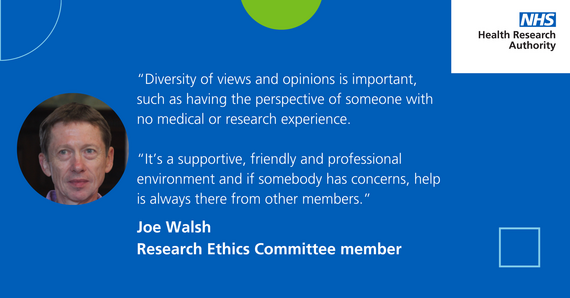
Meet our volunteers: an interview with Joe Walsh
In the latest in our series of interviews with our volunteers, we spoke to Joe Walsh.
Joe is a retired chartered engineer and has been a Research Ethics Committee (REC) lay member for almost a decade.
He tells us about why he decided to volunteer with us, what he enjoys most about his role and the difference RECs make.

Below are some updates you may have missed about health and social care research in the UK:
- NHS England have published two documents to support NHS organisations to undertake research and meet the requirements of the Medium Term Planning Framework:
- Managing research finance in the NHS which provides practical actionable information to make it easier for the NHS to undertake research and manage research finances
- Framework for NHS boards: monitoring research activity provides guidance on what should be included in six monthly research reports to NHS boards, giving them the tools to understand and assess their research activity, income and performance, and to support effective oversight and decision-making
- a new documentary on BBC Radio 4 tells the stories of patients taking part in phase 1 cancer clinical trials at the National Institute for Health and Care Research Clinical Research Facility’s Phase 1 Unit at Guy's and St Thomas' NHS Foundation Trust
- integrated digital tools used in GP surgeries can increase patient safety, according to a landmark study funded by the Department of Health and Social Care through the National Institute for Health and Care Research Clinical Research
- NHS DigiTrials is helping to improve access, increase representation and support the efficient delivery of clinical trials by enabling researchers to reach potential participants who may otherwise be unaware of research opportunities
|






